After reading through Rhetorics, Poetics, and Cultures I was interested by a few points in the book. The first thing that comes to my mind is from chapter 6 "English Studies, Surveying the Classroom." Berlin talks of Freire and how he "sees in the mediating power of language (106)." He went on to say that "While language indeed serves as a means for control and domination, it can also serve as an instrument of liberation and growth (106)." Language, in my opinion, is one of the most powerful weapons a person can yield. It doesn't matter what country you may be from or what language you speak...words are powerful. In the heat of passion a person may yell and scream and say terrible things that could effect you in ways you never thought possible. You may get angry right back or cry. A person's words could also make you physically sick to your stomach. Language can cause great stress in your life. Words can even change your life. My best friend found out she was pregnant last June. When she said to her family and friends "I'm pregnant" our lives changed forever. Even three words like "I have cancer" can shake you to your core because it is life changing. Words can inspire, such as Martin Luther King's "I have a dream" speech or they can cause massive amounts of people to lose respect for you, like when Mel Gibson drunkenly announced that jews were the cause of all the world's wars. Freire would call those examples "codes." Berlin said, "These codes can define subjects as helpless objects of force--economic, social, political, cultural--that render them forever isolated and victimized by the conditions of their experience. These discourses can also, however, form individuals as active agents of change, social creatures who acting together can alter the economic, social, and political conditions of their historical conditions (106)." I like to relate this to that phrase "choose you words carefully."
Going back a little bit in the book, I was struck by something I read on page 39. The paragraph talked about how important a college degree was to have. As we all know (mostly because we are college students) it still is. We have been taught most of our lives that a college degree is the ticket to a better job, more money, and a happier life. At Kutztown all majors have certain core classes that we must take in order to graduate. But we also have those gen ed classes like Biology and some kind of history that EVERYONE has to take. What I didn't know was that "the elective system was created so that students could freely select the curriculum appropriate to their career ambitions. The common core curriculum was simultaneously abandoned--so that by 1897, the only required course for all students at bellwether Harvard was first-year composition (39)." It seems like a fairly logical thing, now that I think about it. Pretty much any job that is going to employ a college graduate will want said graduate to have some kind of basic writing skills, whether it be memos, thank you letters, resumes, or even check lists. A graduate should know how to formulate an idea and be able to put it down on paper logically.
Something I found a little disturbing in the book was found under the subheading "Social Constructionist Rhetoric" on page 85. That theory argues that "each person is first and foremost a member of the community. Thus, any claim to individuality can be articulated only within a social context. Here, the existant, the good, and the possible are determined by consulting the welfare of the populace as a whole (85)." I can understand how important community is, but I still like to think of myself as an individual without having to ackknowledge those around me as making me such. That kind of feels like an oxymoron to me. Of course it also makes sense when I think of that stupid saying coaches use to rev up their teams, "We're only as good as our weakest player." I understand that the populace must be kept happy or at least content, lest chaos is bound to happen. What I refuse to accept is that "the good" can only be found out through the concensus of the people. It's as if the individuals voice makes no difference at all. Hey, let's jump on the bangwagon or else we don't matter! I'll keep my individuality, thank you, because at least I know it's honest and good. I would rather be alone with a true opinion than part of a group with one conformist idea. But hey, that's just me.
Wednesday, March 28, 2007

Friday, March 23, 2007
We are the Blog...Resistance if Futile
Of the four articles we had to read this week, three of them (Aune, Shome, and Blair et al) had to do with incorporating marginalized voices into the discipline of Rhetoric, but one of them (Asante) dealt directly with a reconceptualization of the discipline entire. Asante calls his theory “Afrocentric,” which does not primarily speak to a black or African enthronement of hegemony, but rather of a new way of conceiving Rhetoric and Rhetoric’s importance as a scholarly subject. Asante chooses “Afrocentrism” to describe a relational way dealing with people and subjects. Rather than seeing academia as a compartmentalized, cordoned-off, ice cube tray of an organized phenomenological structure, Asante re-envisions academia (and consequently Rhetoric) as one organic part of a larger organic whole. This larger whole is namely humanity.
Asante poses that in the scholar’s zeal to be smart, to advance, to distinguish him or herself from her peers, and to definitively break from other elements of the grander social tapesry, that universal human characteristics get overlooked. The fact of the matter is that from John Wayne to John Wayne Gacey, we are all of the species human—from the best of us to the worst of us, from the gendered to the transgendered, the righteous to the infamous, the remembered and the forgotten. Asante points out that in Rhetoric this very simple and yet often railed against, vitriol-inspiring truth, is especially done a disservice. Not only does Rhetoric decide what is legitimate and illegitimate within its own scholarly position, it also cuts up communication like a fisherman chums the ocean. Rhetors decide where the boundaries are, the values of, the intents, the functions, and any number of critical, judgment-generating propositions which de-threads the human tapestry until one thread is seen to be so separate that certainly they must seem to come from different cloths. Hickson, among others, push universal human characteristics off the wall, and then claim to have discovered a mass grave of rhetorical body parts ripe for dissection.
I believe in the humanizing, communication-inclusiveness, of Asante. It strikes me that for Rhetoric to finally stop quibbling with itself and get down to business—the business of finding truth, inspiring minds, and bettering people—the subject must find some sort of Master or Uber Rhetoric which includes ALL MODES OF DISCOURSE PERFORMED BY HUMANS. This means the gays…the women…the blacks…the Marxists…the post-colonials…the cheese and mayonnaise eating prig like Hickson…and whoever else can string two words together in a cogent fashion. Rhetoric does not have to be nice, official, sanctioned, proper, or anything other than communicative. Once this is accomplished, I believe Rhetoric can be seen as the unifying force that it is and then begin to tackle a second goal: coming at one’s thoughts, one’s culture, one’s identity, and these qualities all other humans have in different and hopefully more productive ways. Rhetoric should be about asking many, many, questions, instead of being the tin star of the speech police.
I am reminded of Susan Jarratt’s Rereading the Sophists (Hi Susan, first-time caller, longtime fan!), and her desire to break down the classically inspired snobbery of method, action, and participation that led to over 2000 years of elitism when it came to viewing what human knowledge is or isn’t. “We must reject system-based normalities for those which cut across or rise above specific systems. Communication man by his very nature is a creature apart from the narrow confines of a limiting view of the world” (CRT 557). What Asante poses and I herald is a Master Rhetoric inclusive of all human communication. This might be a system, but I would envision it as a system that includes all others—the way the universe includes everything in it. Only then, perhaps, humanity can begin to examine our similarities rather than to point fingers and missiles at our differences.
Asante poses that in the scholar’s zeal to be smart, to advance, to distinguish him or herself from her peers, and to definitively break from other elements of the grander social tapesry, that universal human characteristics get overlooked. The fact of the matter is that from John Wayne to John Wayne Gacey, we are all of the species human—from the best of us to the worst of us, from the gendered to the transgendered, the righteous to the infamous, the remembered and the forgotten. Asante points out that in Rhetoric this very simple and yet often railed against, vitriol-inspiring truth, is especially done a disservice. Not only does Rhetoric decide what is legitimate and illegitimate within its own scholarly position, it also cuts up communication like a fisherman chums the ocean. Rhetors decide where the boundaries are, the values of, the intents, the functions, and any number of critical, judgment-generating propositions which de-threads the human tapestry until one thread is seen to be so separate that certainly they must seem to come from different cloths. Hickson, among others, push universal human characteristics off the wall, and then claim to have discovered a mass grave of rhetorical body parts ripe for dissection.
I believe in the humanizing, communication-inclusiveness, of Asante. It strikes me that for Rhetoric to finally stop quibbling with itself and get down to business—the business of finding truth, inspiring minds, and bettering people—the subject must find some sort of Master or Uber Rhetoric which includes ALL MODES OF DISCOURSE PERFORMED BY HUMANS. This means the gays…the women…the blacks…the Marxists…the post-colonials…the cheese and mayonnaise eating prig like Hickson…and whoever else can string two words together in a cogent fashion. Rhetoric does not have to be nice, official, sanctioned, proper, or anything other than communicative. Once this is accomplished, I believe Rhetoric can be seen as the unifying force that it is and then begin to tackle a second goal: coming at one’s thoughts, one’s culture, one’s identity, and these qualities all other humans have in different and hopefully more productive ways. Rhetoric should be about asking many, many, questions, instead of being the tin star of the speech police.
I am reminded of Susan Jarratt’s Rereading the Sophists (Hi Susan, first-time caller, longtime fan!), and her desire to break down the classically inspired snobbery of method, action, and participation that led to over 2000 years of elitism when it came to viewing what human knowledge is or isn’t. “We must reject system-based normalities for those which cut across or rise above specific systems. Communication man by his very nature is a creature apart from the narrow confines of a limiting view of the world” (CRT 557). What Asante poses and I herald is a Master Rhetoric inclusive of all human communication. This might be a system, but I would envision it as a system that includes all others—the way the universe includes everything in it. Only then, perhaps, humanity can begin to examine our similarities rather than to point fingers and missiles at our differences.
For next week?
Hey,
I know that we are supposed to read the ethnicity in rhetoric book for next week (or something of that nature??) but, how are we going to pick groups for presentations? Any suggestions?
Jen
I know that we are supposed to read the ethnicity in rhetoric book for next week (or something of that nature??) but, how are we going to pick groups for presentations? Any suggestions?
Jen
Thursday, March 22, 2007
Rhetoric Marx the Spot (Post #2)
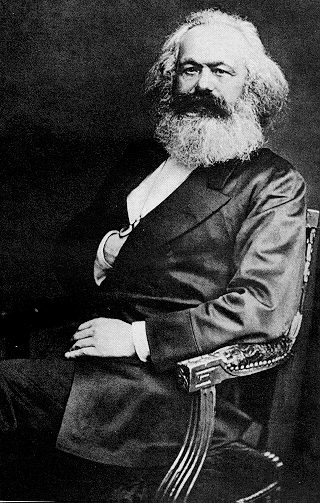
Marxist theory has many holes often resulting in undeniable contradictions. Thusly, the Marxist persuasion has taken many twists and turns, branching off in different directions and developing more like an indeterminate religion than a political theory. In Anue’s article, he mentions the common division of study: scientific and critical. Does a Marxist government occur naturally, following in the wake of a capitalist system that will inevitably crumble, or is it something that must be gained through a revolutionary proletariat, or are they interrelated? Aune asserts that Marxism fills the gap between structure and struggle. Even the rigid capitalist structure must be overthrown by an equally powerful movement with its own select governing body.
There are four way in which Aune describes Marxism as filling in the gap between structure and struggle. The first approach looks at Leninism. He felt that the working class alone can not organize a revolution. There needs to be an organizing party, but as history has show, this group of people lose touch with the workers they represent. Then there is the idea that the revolution will come from not only the working class, but all marginalized people. There will be a direct or voluntary democracy and the economy will be handled by naturally accruing groups. Still, this could result in worse conditions that the capitalist system. There is no telling what will arise.
The last two divisions touch on the rhetorical problems of Marxism. How will these views be instilled on the people? One deals with the Frankfurt School, which I agree with whole heartedly. I like how media is referred to as the “consciousness industry” resulting in “a repressive desublimation of aggressive and erotic instincts” (543). Plus, I think it is valid to say that the only legitimate forms of communication are philosophy and high art. Looking at the United States, media certainly has a greater impact on the group mind, while philosophy and art are under attack. However, I see their views as idealistic and thought rhetorical language should ultimately be avoided, it is necessary to keep their main propositions intact.
Though I am confused on the last school of Marxism, it only points out the problems of mass communication and its attempts to make people feel like they are part of the system by buying commodities. It never gives a clear path in establishing a Marxists system or how it should work.
Aune goes on to discuss Marxism as in rhetoric and criticism today. With rhetoric moving from the hands of the elite to a broader community, a new rhetorical discourse had to be devised. “It had to be replaced by a new standard of discourse, one more tied to print and to the initially egalitarian drive of capitalism to find new markets” (547). I find it ironic that “egalitarian” and “capitalism” are used in the same sentence, but it’s true nevertheless. It is the result of our poststructuralist society where everything is rhetoric, where everything thing subjective. In my opinion, freedom from the capitalist machine and the push for a redistribution of wealth cannot survive unless we are grounded in some form of objectivity. Even a Marxist Derrida would say that in order to make a statement, we would have to stop the chain of signifiers at some point.
My First Post of the Day: I hate Asante
I’m going to respond to James Arnt Aune’s “Cultures of Discourse” because the postcolonial article was boring, I’m sick of feminism, and Asante is a racist. But before I start in on Aune’s piece, I would like to rant about Asante’s ridicules article and how it should never have been published. There is really nothing in his article other than a flat out rejection of Western thought. He makes strong statements that are not cited. Here are a few that I plucked from the beginning of his paper: “social science seems near its end,” we have a “limited view of reality,” Hegel argues that society only exists if all men are free “meaning, essentially, all whites,” “we so easily fall into the trap of believing that what is will always be,” we should “place communication squarely in the middle,” “we get strange social science from African-American and Chinese-American social sciences,” “we cannot see the problem,” “they embarrass themselves,” “unfortunately, this means that you probably know very little about the nature of humankind.”
So what about this communication person that has a broad world view endowed upon him through his connection to African culture? “Unlike other profiles of humanity, that of the communication person reveals the human being as a singularly master of all he or she surveys without becoming a dictator over others; although the communication person possesses the power of information, he or she is checked by a creative belief in the human personality” (557). He later criticizes ethnic foundations of criticism but never argues whether there should be some kind of unified base or no base at all. He has no clear focus, makes inaccurate statements, and preaches about a more collective view while hypocritically stating that the Afro centric view encapsulates this ideal. Maybe the discourse he is preaching against has become so prevalent because it doesn’t rely on “a creative belief in the human personality,” to keep in check, but instead uses intellectual discourse that is constantly building upon and correcting itself.
“The methodological posture which the communication field must take is that all sectors of a society and all societies can be explored, analyzed, and questioned on the basis of their contribution to the human personality” (559). Can someone tell me how this is practical at all? This is a great encompassing view for a field as a whole, but this doesn’t work from one academia to the next. So, that is my rant on Asante. I have to go to an honors club party right now, but I’ll be back with a more conducive response to Aune.
So what about this communication person that has a broad world view endowed upon him through his connection to African culture? “Unlike other profiles of humanity, that of the communication person reveals the human being as a singularly master of all he or she surveys without becoming a dictator over others; although the communication person possesses the power of information, he or she is checked by a creative belief in the human personality” (557). He later criticizes ethnic foundations of criticism but never argues whether there should be some kind of unified base or no base at all. He has no clear focus, makes inaccurate statements, and preaches about a more collective view while hypocritically stating that the Afro centric view encapsulates this ideal. Maybe the discourse he is preaching against has become so prevalent because it doesn’t rely on “a creative belief in the human personality,” to keep in check, but instead uses intellectual discourse that is constantly building upon and correcting itself.
“The methodological posture which the communication field must take is that all sectors of a society and all societies can be explored, analyzed, and questioned on the basis of their contribution to the human personality” (559). Can someone tell me how this is practical at all? This is a great encompassing view for a field as a whole, but this doesn’t work from one academia to the next. So, that is my rant on Asante. I have to go to an honors club party right now, but I’ll be back with a more conducive response to Aune.
Will It Ever End?!
Hey guys. Some bad news. My car was broken into this past Tuesday at Weis Market. Someone smashed in my front passenger side window (in broad freakin' daylight!) and stole from me. All of the text books I had inside were stolen, including the one for this week's post. A little side note of humor though, the only one that wasn't stolen from my car was Ramage. However, I don't think it was ignored for it's content, my cat chewed it up pretty good. So, chances are the thief didn't think it could be sold back. He or she also stole my lunch and makeup! Who does that? Anyway, be careful around Kutztown. What is this world coming to? Well I'm not like most college kids rolling in dough (hahaha) so I couldn't buy a new one. I journeyed to the library but the book wasn't on reserve. It never ends. I'm not quite sure what to do so I'm just going to respond to as many of the blogs that are posted before I have to go to work at 1:00. If there's only one blog, I will respond to more after work. I hope that's alright. Damn you Weis Market! And the Kutztown Police!
The Luckiest Girl In The World,
Justine
The Luckiest Girl In The World,
Justine
Feminine community and alienation in "Disciplining the Feminine"
Hello everyone:) I hope you have all enjoyed a pleasant week off of school. In any event, lets get down to business. (Dr. Mahoney I hope you are enjoying your conference, and I know you will kick some major rhetoric ass while you're there!)
In the readings that were assigned for today, I seriously enjoyed "Disciplining the Feminine" not only because of its unveiling of a white male dominated academia (sorry guys), but also with the connection between the feminist perspectives we all presented on last class. Is a professor's true worth, the quantity of the work that is published? Obviously, I think not. As a mother, I understand the need for women to divide themselves into many areas of life, and when we are focusing on raising families, our work quantity suffers, but the quality does not. In a recent class I had, a young teacher stated that he handed in a 40 page paper, when only a 5 page paper was wanted by the professor. Just because he wrote so much, does not mean he is a better student than most, or even had a better quality paper; however, it shows his lack of a social life and family life. Similarly within the text, the women professors are degraded because of their lower quantities of work after receiving the doctorate. The output that is shown for the men does not necessarily equal the quality of the feminine work; also, as the authors point out, the women profs. tend to write journal articles that are cross spectrum, not solely focusing on what is at hand. Therefore, women build communities in education, not only with those that are like them, but also with those whose discipline differs, which takes greater focus and determination, not to mention more time to fully accomplish a completed work.
The authors, merely in bonding together to create this rhetorical text says much. They are not afraid to build a community amongst themselves, much like Mary Astell and Christine de Pisan insisted were necessary for the true female culture to be able to thrive in an academic setting. The authors quote John Berger who states:
"To be born a woman has to be born, within an allotted and confined space, into the keeping of men [ . . .] But this has been at the cost of a woman's self being split in two. A woman must continually watch herself. . . . From earliest childhood she has been taught and persuaded to survey herself continually. And so she comes to consider the surveyor and the surveyed within her as the two constituent yet always distinct elements of her identity as a woman." (576)
This quote speaks so much in only a few lines. Women, are not allowed community with one another, because they are confined to the job of waiting on men. She is therefore fractured into pieces (like Bahktin and DuBois state) like the double voiced/double consciousness theory expounds. We as women are self alienating. How can we grow intellectually and creatively, if we are forced into a box/confined space? We are reminded that to be good at something we must constantly measure ourselves against some male standard, and if we deviate either way, we are not longer accepted within the constraints of normalcy. If women always fight against themselves they do not have the opportunity to bond with other women, which allows the men in power to use us as pawns, because we are so involved with our alienation, that we cannot create community. This brings to my mind Julia Kristeva's ( I think) idea that there is no true feminine reading possible in any text, because we are stained by the phallocentric dominated world. Therefore, how can we be judged in the same category in academia with men? It is rather unfair and pointless, because we are two separate entities working for differing goals. When we as women are measured alongside men, we will sometimes fall short, because it is the male dominated academia through which we are judged. Can we ever truly rid ourselves of the maleness in our minds? I think as Hickson et. al. demonstrates, it is impossible.
Jen
In the readings that were assigned for today, I seriously enjoyed "Disciplining the Feminine" not only because of its unveiling of a white male dominated academia (sorry guys), but also with the connection between the feminist perspectives we all presented on last class. Is a professor's true worth, the quantity of the work that is published? Obviously, I think not. As a mother, I understand the need for women to divide themselves into many areas of life, and when we are focusing on raising families, our work quantity suffers, but the quality does not. In a recent class I had, a young teacher stated that he handed in a 40 page paper, when only a 5 page paper was wanted by the professor. Just because he wrote so much, does not mean he is a better student than most, or even had a better quality paper; however, it shows his lack of a social life and family life. Similarly within the text, the women professors are degraded because of their lower quantities of work after receiving the doctorate. The output that is shown for the men does not necessarily equal the quality of the feminine work; also, as the authors point out, the women profs. tend to write journal articles that are cross spectrum, not solely focusing on what is at hand. Therefore, women build communities in education, not only with those that are like them, but also with those whose discipline differs, which takes greater focus and determination, not to mention more time to fully accomplish a completed work.
The authors, merely in bonding together to create this rhetorical text says much. They are not afraid to build a community amongst themselves, much like Mary Astell and Christine de Pisan insisted were necessary for the true female culture to be able to thrive in an academic setting. The authors quote John Berger who states:
"To be born a woman has to be born, within an allotted and confined space, into the keeping of men [ . . .] But this has been at the cost of a woman's self being split in two. A woman must continually watch herself. . . . From earliest childhood she has been taught and persuaded to survey herself continually. And so she comes to consider the surveyor and the surveyed within her as the two constituent yet always distinct elements of her identity as a woman." (576)
This quote speaks so much in only a few lines. Women, are not allowed community with one another, because they are confined to the job of waiting on men. She is therefore fractured into pieces (like Bahktin and DuBois state) like the double voiced/double consciousness theory expounds. We as women are self alienating. How can we grow intellectually and creatively, if we are forced into a box/confined space? We are reminded that to be good at something we must constantly measure ourselves against some male standard, and if we deviate either way, we are not longer accepted within the constraints of normalcy. If women always fight against themselves they do not have the opportunity to bond with other women, which allows the men in power to use us as pawns, because we are so involved with our alienation, that we cannot create community. This brings to my mind Julia Kristeva's ( I think) idea that there is no true feminine reading possible in any text, because we are stained by the phallocentric dominated world. Therefore, how can we be judged in the same category in academia with men? It is rather unfair and pointless, because we are two separate entities working for differing goals. When we as women are measured alongside men, we will sometimes fall short, because it is the male dominated academia through which we are judged. Can we ever truly rid ourselves of the maleness in our minds? I think as Hickson et. al. demonstrates, it is impossible.
Jen
Subscribe to:
Posts (Atom)